

Jody Jedele Morning Worship Talk
I’ve heard a lot of Jehovah’s Witnesses talks over the years. Some are boring. Some are bizarre. Some leave me scratching my head. But this one genuinely made me stop and think:

Did I just listen to a Jehovah’s Witness talk, or did I accidentally stumble into a lesson on George Orwell’s 1984?
The talk was given by Governing Body member Jody Jedele and centered on the familiar Jehovah’s Witness concept of “new light” — the idea that Jehovah progressively reveals truth to his organization as his people need it.
On the surface, that sounds reasonable enough. Nobody expects human beings to understand everything perfectly.
Our understanding can develop. We can learn. We can correct mistakes.
But there’s a massive difference between learning something new and reinterpreting being wrong as evidence that you were right all along.
And that distinction is exactly what I wanted to examine.
What Is “Doublethink”?
If you’ve read George Orwell’s 1984, you’ve probably heard of Doublethink.
The basic idea is that a person can hold two contradictory ideas in their mind at the same time and accept both of them as true.
Orwell illustrated the concept through slogans like:
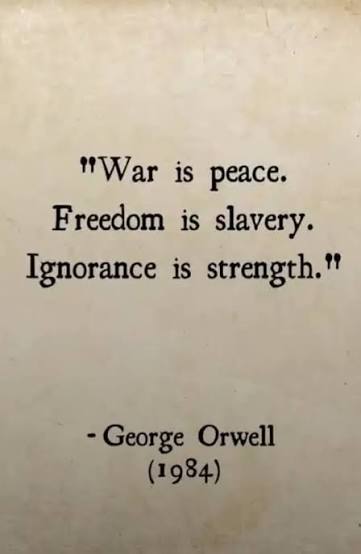
The reason those slogans are so disturbing isn’t simply that they’re false. It’s that the system demands that people accept the contradiction itself.
And that reminded me of something Jody Jedele says throughout this talk. The basic Watchtower argument seems to be: Being wrong is proof that we were right. Failed expectations aren’t necessarily failures. They’re “adjustments.” Changing doctrine isn’t evidence that the organization got something wrong. It’s evidence that “the light is getting brighter.”
And if the organization stops making adjustments? Well, Jody says that’s when we should actually be worried. That is a remarkable framework. Because now the organization has created a system in which both outcomes can support the same conclusion.
If the teaching stays the same, that’s evidence of stability. If the teaching changes, that’s evidence that the light is getting brighter. Either way, the organization wins.
The Timing of This Talk Is Important
There’s another reason I found this particular talk so interesting. It was given just days after Governing Body Update #6, which addressed the organization’s position on blood.
That’s significant because the blood issue isn’t simply some obscure theological question. Jehovah’s Witnesses have historically been taught that accepting certain blood components was prohibited. And Witnesses have made profoundly consequential decisions based on those teachings.
Then the organization changes its understanding. And now we’re told not to become frustrated when there’s another adjustment. We’re told to “smile and agree.” That’s the part that really caught my attention. Because if you’ve spent years being told that a particular policy represents God’s will, what exactly are you supposed to think when that policy changes? According to Jody, apparently: “Smile and agree.”
Don’t be frustrated. Don’t worry. The light is getting brighter.
First, You Have to Accept the Premises
One of the biggest things I noticed while listening to this talk is that Jody has to establish several premises before the rest of his argument can work.
First, organizational changes come from Jehovah, not merely from the Governing Body.
Second, the Governing Body isn’t really acting as an independent group of men making organizational decisions. They’re presenting themselves as servants implementing what Jehovah wants.
Third, these changes are ultimately beneficial. And fourth, the Bible — particularly passages like Amos 3:7 — is being used to establish the idea that Jehovah reveals these matters to his servants.
If you accept those premises, the argument becomes much easier to swallow. If the Governing Body changes something, Jehovah changed it. If Jehovah changed it, there must have been a reason. If there was a reason, the previous understanding wasn’t necessarily a mistake.
And if you question the adjustment, you’re essentially questioning the way Jehovah is revealing light. That’s a pretty powerful rhetorical structure. But there’s a problem. What if the Governing Body itself was simply wrong? That possibility barely gets any room to breathe.
“Jehovah Is Open”
One of the strangest moments in the talk comes when Jody talks about Jehovah being open and revealing confidential matters to his servants. I couldn’t help but notice the irony. Because transparency is something the Watchtower organization has struggled with for decades. The organization tells its members that Jehovah is open with them. But the Governing Body itself operates with an extraordinary amount of institutional secrecy.
That led me to make a point in the video that I think deserves consideration: I suspect God is about as open with the Governing Body as the Governing Body is with the rest of us.
If that’s an unfair conclusion, then there’s a very simple question: Where exactly does the Governing Body get this information? Does Jehovah appear in a Governing Body boardroom?
Does he send them dreams? Does he whisper the next policy adjustment into someone’s ear? Obviously, they don’t describe it that way. And that’s precisely why I think we need to pay attention to the mechanism they’re actually describing. Because saying “Jehovah revealed this” is not the same thing as explaining how you know Jehovah revealed it.
The Daniel Comparison Doesn’t Quite Work
Jody then brings in Daniel. The argument is that Daniel didn’t immediately understand everything that had been revealed through prophecy. The meaning became clearer later, when it was needed. That’s supposed to provide a biblical precedent for modern organizational adjustments. But I think there’s a critical distinction being overlooked. Daniel didn’t make a failed interpretation of Jeremiah’s prophecy and then later correct it. That’s an important difference.
There’s a difference between: “I don’t understand this prophecy yet.” and: “I understand this prophecy, and here’s what it means. ”followed years later by: “Actually, we were wrong about that.” Those aren’t the same thing. If you’re simply waiting for more information, that’s one thing.
But if you make a confident prediction, impose rules based on your interpretation, demand that other people accept those conclusions — and then later reverse yourself — calling the reversal “brighter light” doesn’t automatically explain the original error. Sometimes the simplest explanation is: You were wrong.
The Garage Analogy Reveals the Problem
Jody gives an analogy that I thought was particularly useful because it actually exposes the weakness in the “new light” concept.
Imagine you’re standing in a dark garage. There’s just enough light to see the silhouette of a pickup truck.

Then more light comes on. Now you can see the toolbox. The workbench. The saws. The drills. The shelves. The stairs. And eventually you can see the make, model, and color of the truck. That’s a pretty good analogy for progressive understanding.

But then I realized something. What if the truck wasn’t actually there? What if the original “light” made you think there was a truck, and later you discovered there wasn’t? That’s not more information about the truck. That’s a correction of a mistaken conclusion. And that’s where I think the Watchtower’s use of “new light” gets complicated.

Sometimes new information genuinely does reveal something we didn’t previously understand. But sometimes the organization isn’t discovering additional details about an established truth. It’s reversing a previous conclusion. Those aren’t necessarily the same thing.
What About 1914?
This becomes particularly important when Jody discusses 1914. He explains that early Watchtower publications were already pointing toward 1914 as a significant year. And that’s true to the history he is discussing. But then we have to confront the expectations surrounding that date.
There were expectations about what 1914 would mean. The end of the existing system. The Kingdom taking full control. The anointed being taken to heaven. Those things didn’t happen as expected. And that’s where Jody makes an extraordinary argument.
He says Jehovah essentially adjusted their expectations by not doing what they expected. Think about that sentence for a moment. The prediction doesn’t come true. The predicted event doesn’t happen. And the explanation becomes: Jehovah was teaching them something through what didn’t happen.
That is a very convenient framework. Because now a failed expectation doesn’t necessarily count against the person making the prediction. It can become evidence that God was guiding them.
What Would Actually Falsify the System?
This is the question I kept coming back to while listening.
What would actually convince a Jehovah’s Witness that the organization was wrong? That’s not a rhetorical question. I mean it seriously.
Suppose the Governing Body makes a prediction. It doesn’t happen. The interpretation changes. That’s “new light.” Suppose a policy is enforced for decades. Then the policy changes. That’s “new light.” Suppose an organizational teaching is presented as biblical. Later, the teaching changes. That’s “new light.” Suppose members criticize the change. They’re told to “smile and agree.”
Again, that’s apparently evidence that Jehovah is making the path brighter. At what point does the explanation become unfalsifiable? Because if every correction is evidence of divine guidance, then what possible evidence could demonstrate that the organization was simply mistaken? That’s the question I think deserves much more attention.
“If There Were Never an Adjustment, We Should Be Worried”
This was probably the single most striking statement in the entire talk. Jody says that if there were never an adjustment, we should be worried. Think about how unusual that is. He’s essentially turning organizational change into a test of divine guidance.
No changes? Something is wrong. Changes? The light is getting brighter. So I started thinking about what this logic would sound like in everyday life.
Imagine I give you directions to a city. You follow them. You end up completely lost. I finally admit that my directions were wrong and give you a new route. Would you say: “Wow. Your directions are getting brighter!” No. You’d probably say: “You gave me the wrong directions.” The correction is good. But the fact that you had to correct the directions doesn’t prove that the original directions were correct. That’s the distinction that seems to get lost in the “new light” argument.
Change Isn’t Automatically Evidence of Progress
This is probably the biggest point I took away from the talk. An adjustment isn’t automatically good just because it’s an adjustment. Sometimes changing your mind is a sign of learning. Sometimes it’s a sign that you discovered new information. Sometimes it’s a correction. And sometimes it’s simply an admission — explicit or otherwise — that your previous position didn’t hold up.
There’s nothing inherently shameful about admitting that you were wrong. In fact, admitting you’re wrong can be one of the most intellectually honest things a person can do. But that’s why I kept asking: Where is the apology? If the organization has repeatedly made serious mistakes that affected people’s lives, why isn’t the appropriate response simply: “We were wrong. We’re sorry. We should never have imposed this on you.”
Instead, the language becomes: The light is getting brighter. That changes the emotional meaning of the mistake. The organization doesn’t have to sit in the uncomfortable position of being the institution that got something wrong. It can present itself as the institution through which Jehovah is progressively revealing truth. That’s a very different story.
The Bigger Issue: Obedience
And this brings me to what I think is the most important issue underneath the entire discussion. It’s not really about whether doctrines change. Religious people can change their understanding. That’s normal.
The bigger question is: What level of authority should an organization have when it has a history of being wrong? If an organization admits that its understanding changes, that’s one thing. But what happens when the same organization expects members to obey those teachings while they’re current? What happens when questioning the teaching isn’t merely discouraged, but can result in serious social consequences?
That’s where I think the conversation becomes much bigger than “new light.” Because the issue isn’t simply: “Can the Governing Body make mistakes?” Apparently, even they would acknowledge that their understanding can be adjusted. The real question is: “What should happen when an organization that demands obedience gets something seriously wrong?” That’s a much harder question. And “the light is getting brighter” doesn’t necessarily answer it.
The Real Lesson I Took From This Talk
By the end of the talk, I was left with a very different interpretation from the one Jody intended. He wants Jehovah’s Witnesses to hear: Don’t worry when we make changes. Jehovah is making the path brighter.
What I heard was: Don’t question the changes. Accept them. Smile and agree. And if someone points out that we’ve changed something, tell them Jehovah did it.
Maybe that’s not what Jody intended. But that’s the practical effect of the argument as I heard it. And that’s why I called the talk Orwellian. Not because every statement in it is literally taken from 1984. But because of the underlying logic: The contradiction itself becomes evidence of the truth.
Being wrong becomes proof that you’re right. Failed expectations become evidence of divine guidance. Changing policies becomes evidence of progressive revelation. And questioning the changes becomes a sign that you don’t understand how the light works.
At some point, I think we’re entitled to stop and ask a very simple question: What if the light isn’t getting brighter? What if someone just turned on a different lightbulb because the first one wasn’t working? And maybe that’s the question the Governing Body doesn’t want people asking.